This one took me a while to put together.
Not because I didn't know what happened, but because emergencies involving someone you love are complicated in ways a training scenario can never fully recreate.
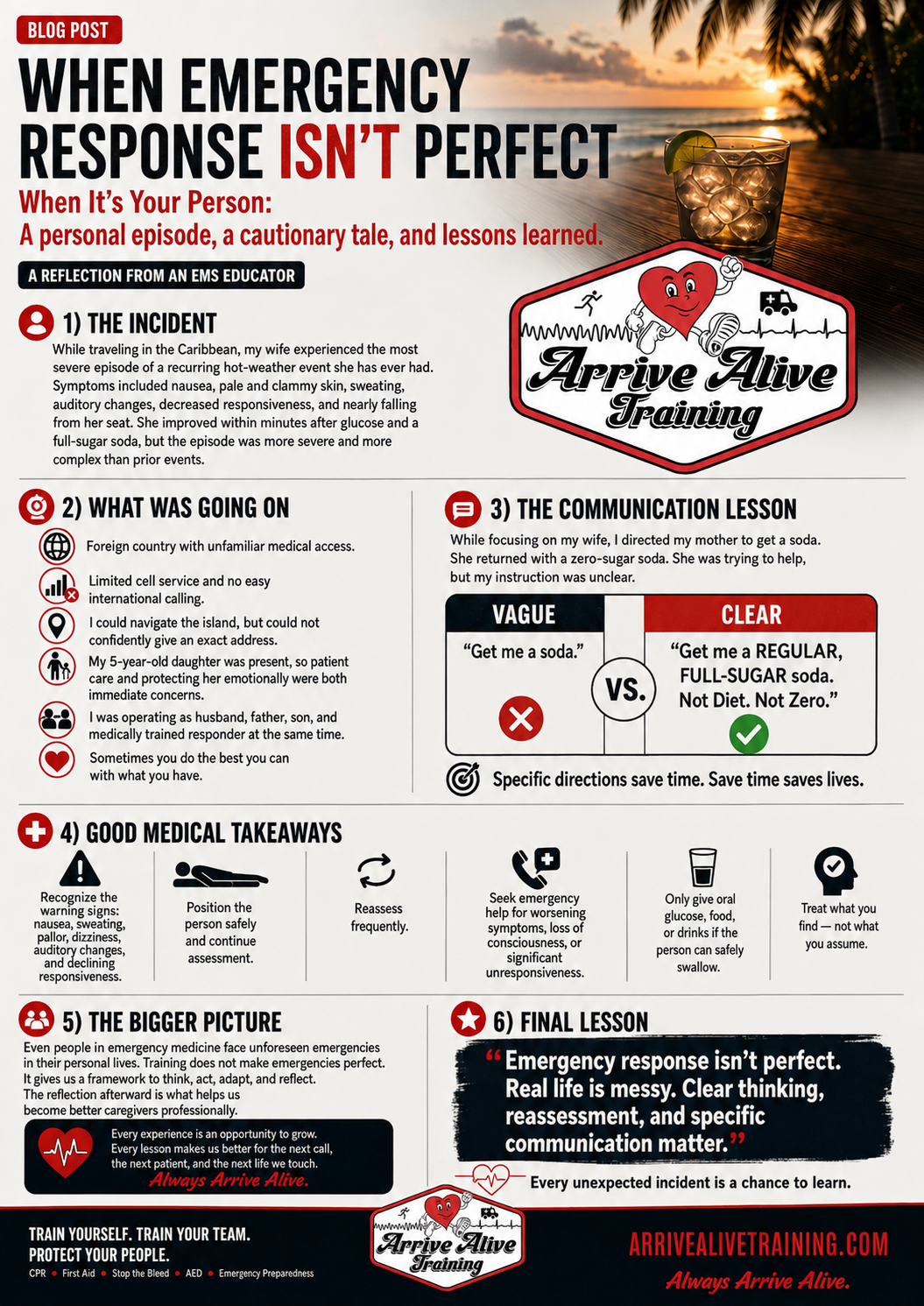
In that moment, I wasn't only someone with an EMS background. I was a husband watching my wife become more altered than I had ever seen during one of these episodes, a father trying to shield my 5-year-old daughter from how serious the situation felt, a son directing my mother to help, and the person everyone was looking to for decisions.
We were also in a foreign country, in a relatively remote location, with unreliable cell service, limited international calling, no diagnostic equipment, uncertainty about how quickly EMS could be accessed, and no simple street address I could give a dispatcher.
A judgment call had to be made.
Based on her history, what I was seeing, and the resources available, I began care and kept reassessing her. I administered oral glucose while she was altered, but she could still follow a direct command to chew and swallow.
That distinction matters.
Standard first-aid guidance is clear: oral glucose, food, or drink should not be given to someone who is not awake or cannot safely swallow. Had she become unconscious, stopped following commands, or been unable to protect her airway, my approach would have changed.
I'm not sharing that decision as a treatment recommendation. I'm sharing the reality that sometimes, in an imperfect environment, you have to make decisions before you have every piece of information or every resource you would want.
Then came one of the simplest lessons of the night.
I told my mother, "Get me a soda."
She returned with a zero-sugar soda.
She hadn't done anything wrong.
My instruction wasn't specific enough.
What I meant was:
"Get me a regular, full-sugar soda. Not Diet. Not Zero."
That moment reinforced something I teach all the time: in an emergency, clear and specific communication matters.
Emergency response isn't perfect.
Training doesn't remove emotion, uncertainty, limited resources, family responsibilities, communication problems, or difficult decisions.
What it gives you is a framework:
Recognize. Assess. Act. Reassess. Communicate. Adapt.
And afterward, reflect.
What worked? What could have been safer? Were my directions clear? What assumptions did I make? What would I want available next time?
Sometimes you simply do the best you can with what you have.
Then you learn from it.
And if you're willing to reflect on those moments—the good decisions and the imperfect ones—they can make you a better caregiver, instructor, leader, husband, father, and person.
Stay prepared. Always Arrive Alive.
This post is for informational and educational purposes only; it is not meant to be used as medical advice or in lieu of formal emergency training.