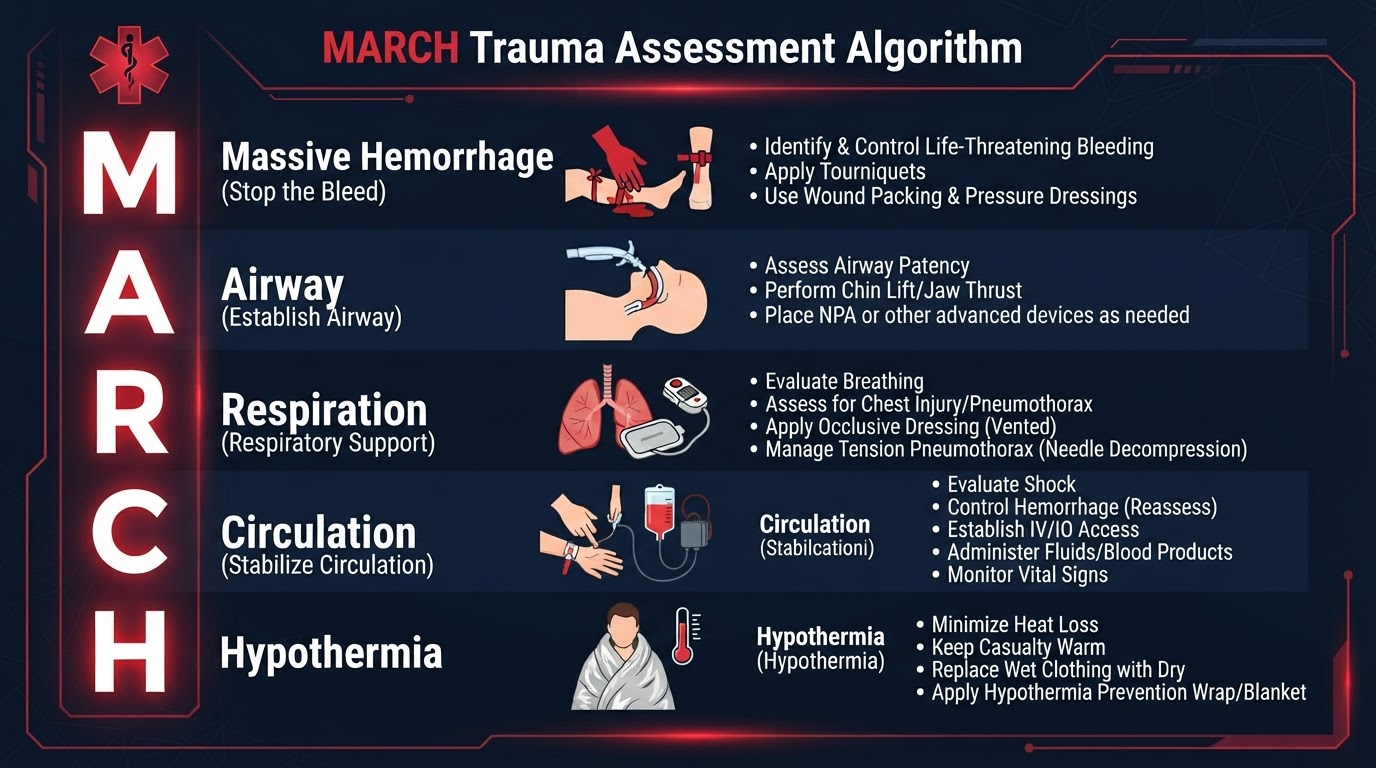
The acronym MARCH shows up everywhere now—trauma courses, medical cards, range bags, social-media videos, and first-aid kits. That visibility can be useful. It gives people a way to organize priorities when a serious injury creates confusion.
It can also create a problem.
Someone sees a five-letter sequence and assumes they are expected to perform every medical intervention associated with military or tactical medicine. They buy equipment they have never opened, watch a short video, and come away with more confidence than judgment.
That is not preparedness.
MARCH is a framework for thinking in order. It is not a universal civilian protocol, a substitute for hands-on training, or permission to work outside your role. The practical value is knowing which threat cannot wait, taking the actions you are trained to take, and getting the patient into the emergency medical system without creating another victim.
What MARCH means
MARCH is commonly expanded as:
M — Massive hemorrhage
A — Airway
R — Respiration
C — Circulation
H — Head injury/Hypothermia
The sequence is associated with Tactical Combat Casualty Care. Tactical Emergency Casualty Care adapts military lessons for civilian high-threat environments, with attention to civilian systems, populations, protocols, and operational limits. Formal TECC education is role-specific: NAEMT lists distinct provider and law-enforcement/first-responder courses rather than treating one curriculum as appropriate for everybody.
That distinction should carry into community training. A civilian learner, a security officer, a police officer, an EMT, and a paramedic may use the same mental priorities while having very different skills, equipment, authority, and medical direction.
Why massive bleeding comes first
In a major trauma patient, uncontrolled external bleeding may kill quickly enough that it moves to the front of the assessment.
For the public, the useful lesson is not complicated. The American College of Surgeons' Stop the Bleed program teaches people to recognize life-threatening bleeding and control it through three hands-on actions: direct pressure, wound packing, and tourniquet application. The program also begins with scene safety and alerting emergency services.
Those skills require practice. Pressure must be firm and sustained. Packing requires getting material into the wound and maintaining pressure. A tourniquet must be the right tool, placed correctly, and tightened until the severe extremity bleeding stops. A training manikin and trainer tourniquet give immediate feedback that a social-media clip cannot.
The order matters because people often get distracted by the most dramatic-looking injury rather than the most immediate threat. MARCH is useful when it redirects attention to catastrophic bleeding that can actually be controlled.
Airway and respiration do not mean "perform an advanced procedure"
After major bleeding is addressed, the framework moves to airway and respiration. This is where scope confusion becomes dangerous.
For a trained civilian, useful actions may include checking responsiveness and normal breathing, calling 911, positioning a patient when appropriate, beginning CPR and using an AED when indicated, and following dispatcher instructions. A trained responder may have additional first-aid or agency-approved skills.
It does not mean that every person carrying a trauma kit should attempt an invasive airway or chest procedure. Equipment does not create competence. A decompression needle in an online kit does not authorize or prepare a civilian to use it. Even among professionals, interventions depend on credential, protocol, medical direction, patient presentation, and operating environment.
The correct response is often less cinematic: make the scene safe enough to work, summon help early, control the immediate life threat, monitor the patient, and provide a clean handoff.
Circulation is more than finding a pulse
Circulation means looking beyond the first bleeding wound. A civilian cannot correct internal bleeding in the field, so early recognition and transport matter. Call 911, monitor the patient, report changes, and do not delay emergency care while searching for gear. Do not let a temporarily alert patient convince everybody that the emergency has passed.
Hypothermia is not only a winter problem
The "H" helps prevent another common mistake: focusing on the wound while ignoring the whole patient.
An injured person can lose heat on a warm day, especially when clothing is removed, the patient is lying on the ground, or blood loss and shock are present. Move the person out of direct environmental exposure when it can be done safely, insulate them from the surface, cover them, and avoid unnecessary exposure while continuing to monitor.
Head injury is also represented in many versions of the mnemonic. For the public, that means noticing changes in mental status, vomiting, worsening confusion, unequal movement, seizure activity, or a declining level of responsiveness and reporting those findings. It does not mean attempting to rule out a brain injury at the scene.
The trauma-care chain is getting more advanced
On August 18, 2026, NHTSA's Office of EMS hosted a federal EMS Focus session on establishing a prehospital blood-transfusion program. The series addresses science, blood suppliers, funding, regulations, training, and program quality.
That is important progress at the EMS-system level. It is also a useful reminder about roles.
A bystander may stop catastrophic external bleeding. A law-enforcement officer may provide care while operating within a dangerous scene and an agency protocol. EMS clinicians may perform assessments and interventions based on certification and medical direction. Some systems can now bring blood products closer to the patient. Trauma centers provide definitive care.
These are connected layers, not interchangeable jobs. The bystander's work does not become less important because the ambulance is more capable. Early bleeding control may protect the patient long enough for advanced care to matter.
Build a trauma kit around trained actions
A basic bleeding-control kit should support the skills the owner can actually perform. Gloves, packing material, pressure dressings, and quality commercial tourniquets are common elements. The exact contents should match the user, environment, organizational risk assessment, and training.
Separate training gear from response gear. Repeated practice should use clearly marked trainer tourniquets and dedicated training supplies. Operational equipment should remain ready for an actual patient and be inspected for damage, contamination, missing components, or packaging problems.
Do not add advanced devices because they look impressive. For every item, identify who is trained to use it, where it belongs, how it is inspected, and whether anyone has practiced with it. Unanswered questions create false reassurance rather than readiness.
Train the decision, not just the hand movement
Wound-packing and tourniquet skills matter, but a useful trauma class should also test judgment.
Can the learner identify which wound is immediately life-threatening? Can they decide whether direct pressure, packing, or an extremity tourniquet fits the injury? Can they communicate the location and patient condition to 911? Can they keep working when the first attempt is ineffective? Can they reassess and provide a clear handoff?
Scenario-based practice reveals problems that clean, step-by-step demonstrations hide. Gloves tear. Equipment is in the wrong pocket. The patient is on the ground. Another person is talking over the 911 caller. The first intervention does not stop the bleeding. That is where a framework such as MARCH becomes useful: it brings the responder back to priorities.
What a prepared civilian should remember
If you are not operating under a professional protocol, keep the plan disciplined:
• Protect yourself and assess the scene. Do not enter an ongoing hazard simply because medical equipment is available.
• Call 911 early. Give the exact location, nature of the emergency, patient count, and known hazards.
• Control life-threatening external bleeding with trained skills. Use direct pressure, packing, or an appropriate tourniquet.
• Check responsiveness and breathing. Begin CPR and use an AED when indicated and within your training.
• Keep the patient protected, monitored, and warm. Report meaningful changes.
• Meet and brief responders. Tell them what happened, what you found, and what you did.
That may sound less dramatic than "tactical medicine." It is also far more useful.
The bottom line
MARCH is valuable because serious trauma punishes disorganized thinking. But the acronym only works when it is paired with appropriate training, honest scope, reliable equipment, and repeated practice.
Arrive Alive Training's Stop the Bleed and Basic Trauma/MARCH programs focus on those practical decisions. We teach the public-facing bleeding-control skills, then build scenario-based training appropriate to the audience—community members, security personnel, law enforcement, workplace teams, or other organizations. The goal is not to make everyone a medic. It is to help each person do the right work, in the right order, until higher care arrives.
This post is for informational purposes only, it is not meant to be used as medical advice or in lieu of proper training