CPR and First Aid certification matter. They establish a recognized baseline, give people hands-on practice, and help organizations meet training requirements.
But a valid card does not automatically mean a workplace, school, gym, nonprofit, security team, youth program, or community organization is ready for an actual emergency.
An emergency rarely arrives in the clean, controlled way we practice an isolated skill. The person may collapse in a locked room. The AED may be on another floor. The employee who knows where the first-aid kit is may be off that day. The person calling 911 may not know the building address or the best entrance for EMS. Everyone may assume someone else is taking charge.
That is the gap between training and operational readiness.
OSHA's Safe + Sound Week runs August 10–16, 2026. The campaign is built around the value of year-round safety and health programs that identify and manage hazards before they cause harm. It is a good reason to stop looking only at expiration dates and ask whether your emergency plan would actually work today.
Here are seven questions every organization should answer.
1. Who recognizes the emergency and starts the response?
"Someone should call 911" is not a role assignment.
In a real emergency, hesitation grows when responsibility is vague. Staff should understand who is expected to assess the situation, who calls 911, who retrieves the AED or first-aid equipment, who meets EMS, and who manages the surrounding area.
That does not mean one person must always perform one task. It means the organization has discussed the tasks before the emergency and trained enough people to cover different shifts, absences, and locations.
A simple drill will expose the difference. Ask staff what they would do if someone collapsed in the break room. If five people give five different answers—or everyone points to the same employee—the plan needs work.
2. Can people reach the equipment immediately?
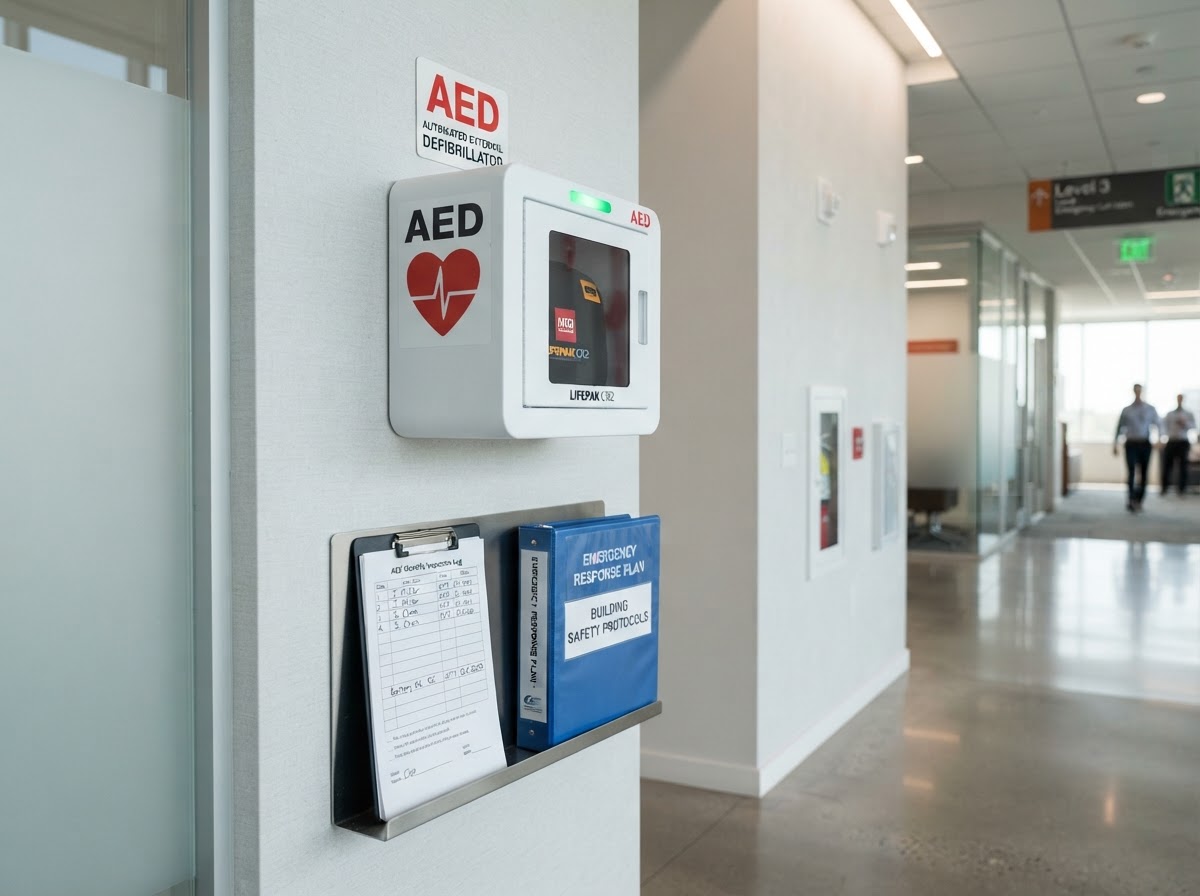
An AED mounted on a wall is not automatically a ready AED.
The device needs a visible, accessible location. Its status indicator should show that it is ready. Pads and batteries need to be connected, within date, and appropriate for the people the organization serves. Staff should know where it is without searching.
The same applies to first-aid supplies, bleeding-control equipment, emergency medications maintained by the organization, gloves, barrier devices, and communication tools.
Ask the question after normal business hours, too. Is the AED behind a locked office door? Is the first-aid kit accessible when a weekend program is running? Does a temporary employee know where the equipment is?
If equipment cannot be reached when it is needed, it is not part of the response plan. It is inventory.
3. Does the training match the actual environment?
The right course depends on the audience and the risk.
A healthcare provider may need BLS. A daycare or youth program may need Pediatric First Aid CPR AED. A workplace may need First Aid CPR AED. A security team, range, construction site, outdoor program, or remote operation may benefit from additional bleeding-control, trauma, or wilderness-medicine training.
Organizations should also verify which credential and delivery format meet their employment, licensing, contractual, or regulatory requirements. The American Heart Association currently offers classroom, blended, virtual, and self-guided options across its Heartsaver portfolio, but those formats are not interchangeable for every employer or requirement. Hands-on skills verification remains part of recognized certification pathways.
The goal is not to purchase the broadest class available. It is to match the training to the people, setting, likely emergencies, and actual requirement.
4. Can EMS find and reach the patient?
Calling 911 is only one step.
Large buildings, campuses, gated properties, warehouses, schools, outdoor sites, and multi-tenant locations create access problems. Responders may need a specific entrance, gate code, elevator, stairwell, room number, trailhead, or meeting point.
Someone should be assigned to meet EMS and direct them to the patient. The 911 caller should know the exact address and any location details that matter. If the organization has security or a front desk, that team needs to understand the medical-response plan as well.
Time spent looking for the correct door is time not spent treating the patient.
5. Does the plan cover the people who are actually there?
Emergency plans should reflect the real population—not an imaginary group of healthy adults who all speak the same language and can move without assistance.
Consider children, older adults, people with disabilities, visitors, contractors, customers, employees working alone, people with limited English proficiency, and anyone who may need help evacuating or communicating.
Schools and youth programs should also account for reunification, emergency contacts, medication procedures, parent communication, and supervision during evacuation or sheltering. CDC guidance encourages schools to build partnerships, assess their needs, maintain supplies, and conduct training and exercises so staff and students understand the emergency operations plan.
A plan is only usable if it works for the people present when the emergency occurs.
6. Has anyone checked the plan against the site's real hazards?
Every organization has a different risk profile.
A gym should think about sudden cardiac arrest, exertional illness, falls, and head injuries. A daycare should prioritize pediatric emergencies, choking, allergic reactions, illness, and reunification. A construction company must account for trauma, falls, environmental exposure, and access challenges. A security team may need medical response during a violent or rapidly changing incident. An outdoor program must plan for delayed EMS access, navigation, weather, and evacuation.
Start with the emergencies that are both plausible and consequential. Then verify that training, equipment, communication, and procedures address them.
This is not about predicting every possible event. It is about making the most likely and most serious events less dependent on luck.
7. Has the organization practiced recently?
Written plans often look complete until people try to use them.
A short drill can answer practical questions:
• How long did it take to recognize the emergency?
• Who called 911?
• Who began care?
• How long did it take to retrieve the AED or trauma kit?
• Did anyone meet EMS?
• Could staff describe the location clearly?
• Were doors, gates, hallways, or elevators a problem?
• Did anyone document what happened and restock the equipment afterward?
The purpose of a drill is not to embarrass anyone. It is to find friction before a real patient pays for it.
A 20-minute readiness check
An organization does not need a large exercise to get started. Walk through one realistic scenario this week:
• Pick a likely emergency in a real location.
• Ask staff to explain the first five actions.
• Time how long it takes to retrieve the AED or first-aid equipment.
• Identify the entrance EMS would use.
• Confirm the equipment is accessible and within date.
• Write down the three biggest points of confusion.
• Assign one person and one deadline to correct each problem.
That simple review will tell you more than another policy sitting in a binder.
The bottom line
Certification is part of preparedness. It is not the entire preparedness program.
Real readiness connects the card in someone's wallet to the equipment on the wall, the roles in the plan, the hazards in the building, and the actions people can perform under pressure.
Arrive Alive Training provides CPR/AED, First Aid, BLS, bleeding-control, trauma, emergency-preparedness, active-violence, and wilderness first-aid training for organizations and community groups. Training can also be paired with scenario based drills to ensure learning comprehension.
If your organization has valid cards but has never tested the response, this is a good week to start.