Most people do not shop for CPR training because they enjoy comparing course descriptions. They have a practical reason: a job requires a card, a school asked for documentation, a youth program wants staff trained, or somebody in the family had a close call and now the whole group wants to know what to do.
Then the search results create a new problem. One class is short and inexpensive. Another costs more and takes longer. One says "community CPR." Another says "certification." A third is online only. They may all use similar words—CPR, AED, choking, First Aid—but they do not necessarily produce the same outcome.
That does not mean one is good and the other is bad. It means they are built for different jobs.
Before you book, answer one question: Do you need practical skills, a recognized course completion card, or both?
A community workshop is built to get more people willing to act
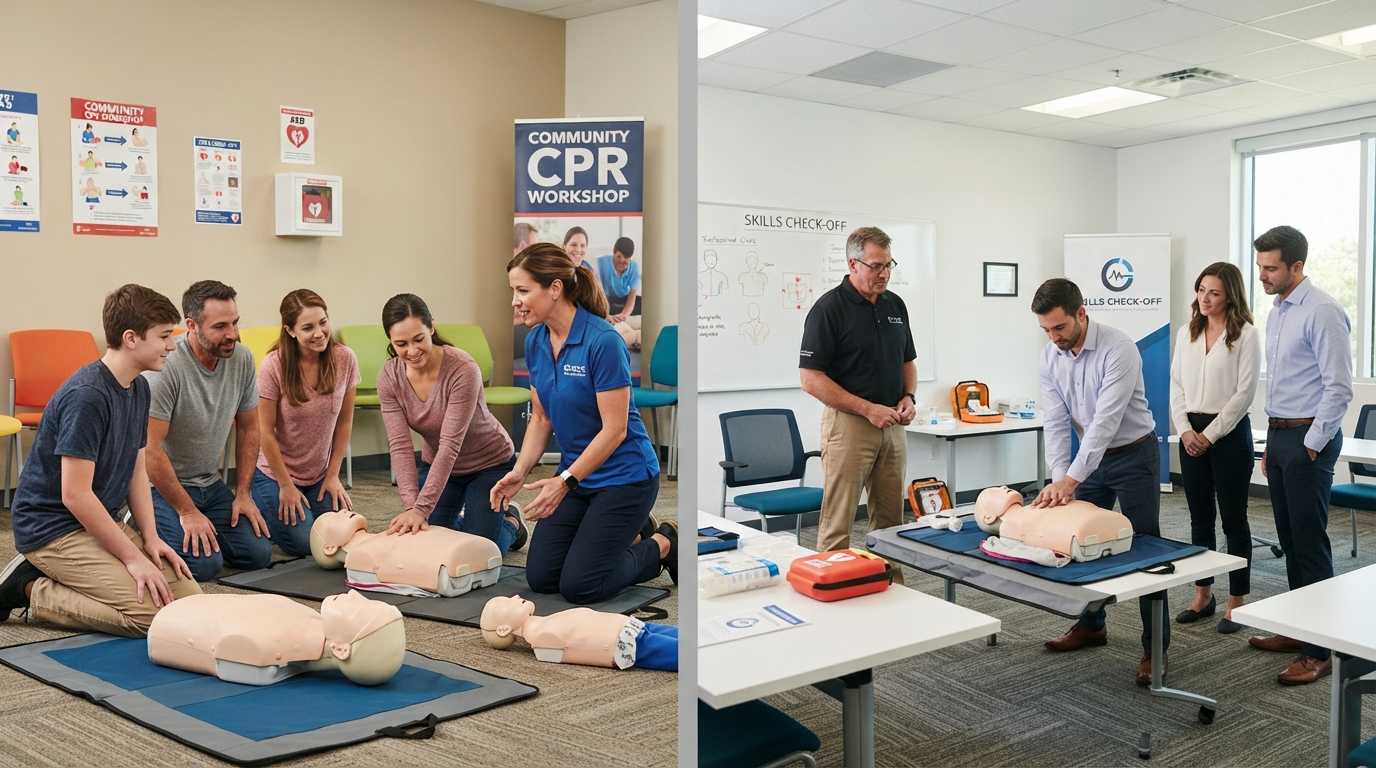
A good community CPR workshop lowers the barrier to learning. It gives parents, grandparents, coaches, volunteers, faith groups, neighborhood organizations, and ordinary bystanders a practical introduction to lifesaving actions.
For example, the American Heart Association's Family & Friends CPR program teaches adult Hands-Only CPR, adult CPR with breaths, child and infant CPR, AED use, and choking relief. It is designed for people who want to learn but do not need a course completion card to satisfy a job requirement. It can be taught in a group using practice-while-watching methods, and participants receive a certificate of participation rather than a workplace credential.
That distinction matters, but it should not be mistaken for "less important."
Most cardiac arrests happen outside a hospital. The person nearby is not usually an emergency clinician. It may be a spouse, coworker, neighbor, or customer. Community training is valuable because it helps ordinary people recognize a problem, call 911, begin CPR, use an AED, and keep going until help arrives.
A well-run community session should be active. People should get their hands on manikins, see an AED demonstrated, practice the sequence, ask questions, and leave with a simple plan they can remember. It should not be a long lecture disguised as training.
Community workshops are also a natural place to add bleeding-control awareness. The American College of Surgeons' Stop the Bleed program teaches three basic actions to control severe bleeding, and more than five million people have reportedly been trained. When scope, time, equipment, and instructor qualifications are appropriate, CPR and bleeding-control awareness make a practical community-readiness pairing.
A credentialed course is built to meet a defined standard
If your employer, licensing body, school, agency, camp, childcare program, healthcare facility, or contract requires documentation, a participation certificate may not be enough.
This is where course title and issuing organization matter.
The American Heart Association's Heartsaver portfolio includes classroom, blended, virtual, and self-guided options, with recognized two-year course completion cards. Heartsaver Total is positioned for people who need training that meets job, regulatory, or OSHA-related requirements. Healthcare personnel may instead need Basic Life Support, commonly called BLS, depending on their role and employer.
A technical note: the AHA explains that it does not "certify" individuals. It issues course completion cards showing that a person satisfactorily completed the course and demonstrated the required skills at that time. In everyday conversation, people still say "CPR certification." The safer question is: What exact course completion card does the employer or regulator require?
Do not guess from a generic class title. Ask the person or organization requesting the training for the exact program, provider, and format they accept.
Online-only training can create an expensive surprise
Online education can be useful. It can also be misunderstood.
The American Red Cross states that its online-only CPR course does not qualify a student for workplace certification; blended or in-person training is needed for that outcome. Other providers use different delivery models, so the rule is not "online is always invalid." The rule is: verify the required hands-on skills session and credential before paying.
If a course promises instant certification after watching videos and answering questions—with no skills check—slow down. Ask who issues the card, what course name will appear on it, whether there is an in-person or approved skills component, how the credential can be verified, and whether the requesting employer accepts it.
Saving an hour at registration does not help if you have to repeat the entire course later.
Price follows the outcome—not just the number of minutes
It is reasonable to compare prices. It is not reasonable to assume that every listing called "CPR" contains the same product.
A community workshop can often serve more people at a lower cost because it is built for awareness and participation. A credentialed course may include a defined curriculum, student materials, instructor oversight, individual skills evaluation, administrative processing, and an issued course completion card. Blended programs may also have a separate online component before the hands-on session.
None of those items automatically guarantee a great class. They do explain why a legitimate card-bearing course and a community event may sit at different price points.
Ask for the total cost and the complete outcome. A $45 workshop can be a good value if you want community education and it is labeled honestly. It is a poor value if you expected a card your employer will accept. A higher-priced course can be a good value if it gives you the correct training, hands-on evaluation, materials, documentation, and support. It is a poor value if the provider cannot explain what you are buying.
Do not let the lowest number make the decision before the requirement does.
The format should support practice, feedback, and correction
People sometimes judge a course by one visible feature: in person versus online, large group versus small group, or instructor-led versus self-guided. Those distinctions matter, but the real question is whether the learner gets the practice and feedback required for the course outcome.
In a community workshop, that may mean enough manikins and AED trainers to keep participants moving, a facilitator who can answer questions, and time to repeat the sequence until it feels less foreign.
In a credentialed course, it also means completing the required skills work and evaluation for that program. A small class can still be poorly organized. A larger group can still be effective when equipment, staffing, and stations are planned correctly. Technology can provide immediate feedback, but learners still need to understand what the feedback means and how to improve.
Before registering a group, ask how many learners share each manikin, how practice is organized, how skills are evaluated, and what happens if somebody needs another attempt. These questions tell you more than a stock photo of a classroom.
Three common booking mistakes
• Mistake one: choosing by title alone. "CPR class" may describe a community awareness event, a workplace CPR/AED course, or BLS. Read beyond the headline.
• Mistake two: treating every card as interchangeable. A card can be real and still be the wrong card for a particular role. The employer or regulator decides what it accepts.
• Mistake three: waiting until the deadline. If the learner discovers after the course that the format or provider is not accepted, there may be no time to correct it before a shift, school placement, license renewal, or program opening. Verify first and leave room for completion, documentation, and any required follow-up.
The practical comparison
• Community CPR workshop — Primary goal: Build awareness, confidence, and willingness to act. Best fit: Families, community groups, volunteers, general public. Documentation: Often a participation certificate; not normally a workplace card. Format: Flexible group instruction with practice. Time and price: Usually shorter and lower-cost. Key risk: Assuming participation equals job qualification.
• Credentialed CPR/AED or BLS course — Primary goal: Meet a defined training standard and document successful completion. Best fit: Employees, healthcare personnel, regulated roles, students with stated requirements. Documentation: Recognized course completion card, if the course and provider match the requirement. Format: Structured curriculum, required skills practice and evaluation. Time and price: Usually longer and higher-cost because of curriculum, materials, evaluation, and credentialing. Key risk: Booking the wrong provider, course, or format for the role.
The chart is a guide, not a legal determination. Requirements vary by job, employer, agency, and jurisdiction.
Six questions to ask before registering
1. Why am I taking the course? If the answer is "my job told me to," get the requirement in writing. If the answer is "I want my family to know what to do," a community workshop may be the right starting point.
2. What exact course is required? CPR/AED, First Aid, pediatric First Aid/CPR/AED, and BLS are not interchangeable labels.
3. Who issues the card or certificate? Ask for the actual issuing organization—not just the training company's name.
4. Is there hands-on practice and a skills check? If a credential is required, confirm the accepted format before you register.
5. What is included in the price? Ask about digital or printed materials, skills sessions, cards, rescheduling, retesting, and any separate online-course charge.
6. Can the credential be verified? For example, AHA eCards can be verified through the organization's eCard system. Employers should know what documentation they are receiving.
Strong organizations use both pathways
This is not an either-or decision for every organization.
A business, school, house of worship, community organization, or youth program may need a core group of staff to hold the correct credentials. The same organization may also want a broader awareness workshop for volunteers, parents, members, or the public.
That layered approach can make sense:
• Identify the roles that must hold a specific card.
• Put those people in the correct credentialed course.
• Offer a separate community workshop to expand awareness and participation.
• Review the AED location, emergency action plan, communications, and supply readiness so training connects to the actual site.
The mistake is not offering two levels of training. The mistake is blurring the line between them.
The bottom line
The right CPR class is the one that matches the learner's purpose.
If you need a workplace or professional credential, confirm the exact course and accepted format before you pay. If you want practical, accessible training for a family or community group, do not dismiss a workshop simply because it does not issue a job card. A well-designed workshop can give more people the confidence to start—and starting matters.
Arrive Alive Training can help individuals and organizations sort the options before registration. We provide CPR/AED, First Aid, BLS, bleeding-control and trauma education, AED readiness support, and group training. Tell us who needs training and why. We will recommend the appropriate path, including when a community workshop is useful and when a recognized course completion card is required.